In this articleShowHide
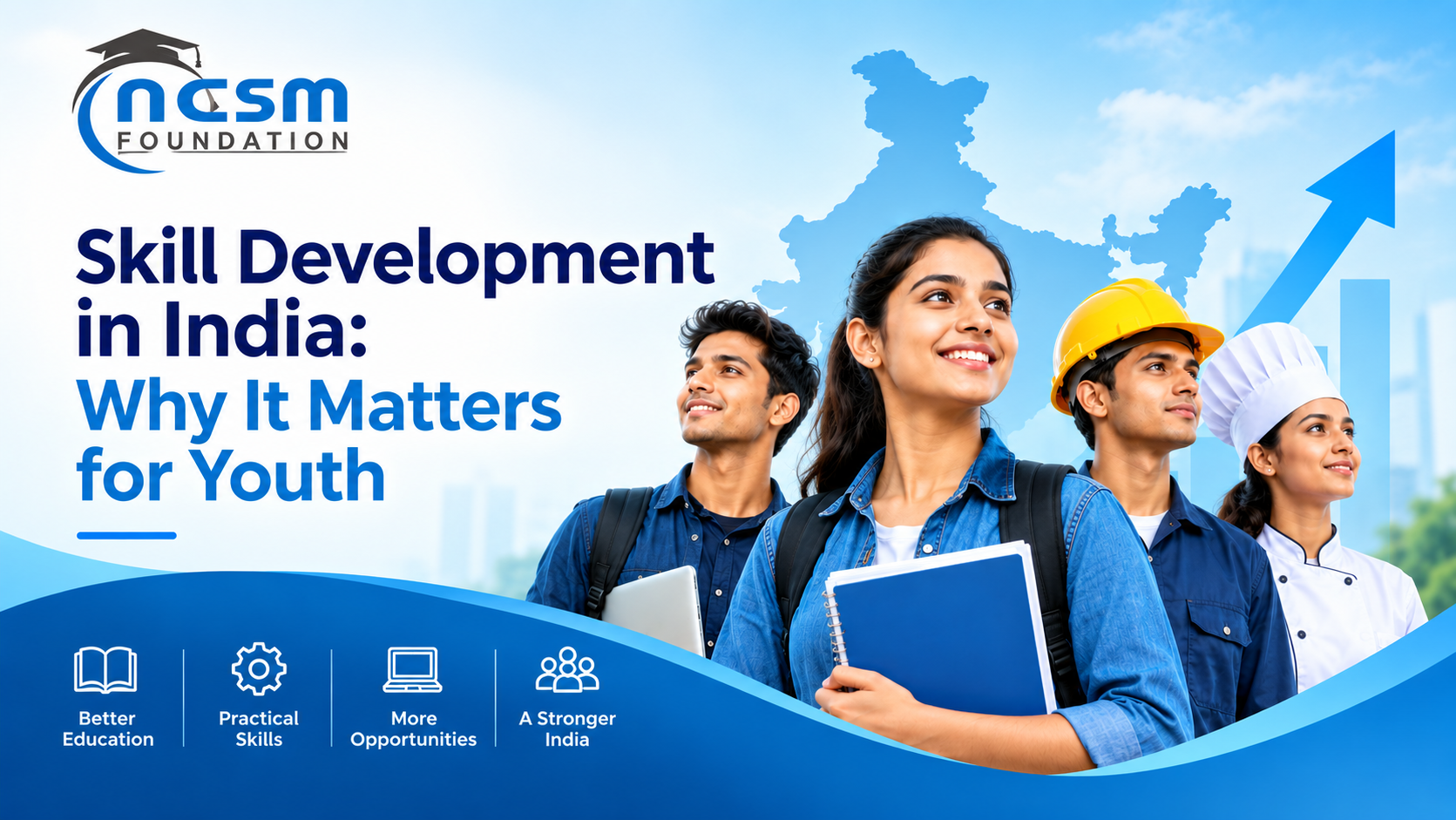
India stands at a pivotal demographic crossroads. With over 65% of its population under the age of 35, the country holds one of the largest talent reserves in the world. However, demographic volume alone does not translate directly into economic progress. For this demographic dividend to fuel sustainable national growth, education must be coupled with market-aligned, practical capabilities. Skill development in India has transitioned from an optional career booster to a fundamental national necessity, transforming academic foundations into productive, sustainable livelihoods.
What Does Skill Development Mean?
Skill development is often narrowly misconstrued as training for basic manual labor or memorizing a single repetitive task. In reality, modern youth skill development is a multi-dimensional framework spanning three core areas:
Technical and Vocational Proficiencies: Specialized know-how required for specific trades, machines, and digital platforms.
Cognitive and Industry Skills: Analytical problem-solving, structured troubleshooting, and workflow coordination.
Workplace Readiness & Soft Skills: Interpersonal communication, professional ethics, teamwork, and business adaptability.
True capability merges technical mastery with digital agility. Whether mastering modern mechanical trades through structured ITI training courses or building competitive advantages in AI and emerging technology skills, structured upskilling transforms raw ambition into professional execution.
Why Practical Learning Matters
Academic qualifications validate theoretical knowledge, but employers hire for execution. Two candidates may possess identical diplomas, yet their workplace readiness diverges sharply the moment they face real-world workflows.
Hands-on training eliminates the gap between textbook theory and operational reality. In fast-evolving sectors—including healthcare, IT services, electronics, automotive engineering, retail, and logistics—work environments do not operate under sterile academic conditions. When students train on live systems, run diagnostics, and fix genuine operational faults during their education, they enter the job market with demonstrable problem-solving capacity rather than unapplied theory.
Skill Development and Employability
The modern job market faces a paradox: millions of graduates seek employment, while businesses struggle to fill vacancies due to an absence of industry-ready skills.
Employability is rarely determined by test scores alone. Hiring managers evaluate candidates across a composite matrix:
Employability = Technical Literacy + Practical Competence + Adaptability + Workplace Communication
Targeted skill development programmes align curricula directly with industry standards. Through accredited certifications, hands-on lab work, and competency-based assessments, vocational training programs ensure that learners do not require prolonged, costly corporate retraining before becoming productive team contributors.
Skills Can Also Create Self-Employment Opportunities
A traditional corporate job is not the sole benchmark of career success. In an expanding economy, vocational training India provides a direct springboard into entrepreneurship and independent livelihoods.
A strong practical foundation empowers individuals to establish viable local enterprises across varied sectors:
Technical Services & Diagnostics: Consumer electronics, electrical installations, HVAC maintenance, and auto mechanics.
Creative & Consumer Trades: Commercial tailoring, beauty and wellness services, and craft manufacturing.
Digital Micro-Enterprises: Hardware maintenance, localized digital marketing, web assistance, and data services.
When practical craftsmanship is reinforced with basic bookkeeping, client relationship management, and marketing knowledge, technical learners step into the market not just as job seekers, but as micro-employers.
Taking Training Beyond Urban Centres
Economic opportunity has historically concentrated in major metropolitan corridors, leaving semi-urban, rural, and underserved populations at a disadvantage. Long commutes and migration costs frequently prevent talented rural youth from accessing quality institutes.
Decentralized skill initiatives remove these geographical barriers. By establishing training hubs, mobile learning units, and community-level classrooms, organizations like NCSM Foundation expand access to industry-standard learning. Bringing vocational infrastructure closer to communities prevents distress migration and catalyzes regional rural and small-town economies.
The Role of Continuous Learning
Rapid automation, artificial intelligence, and digital workflows have made technical obsolescence an ongoing challenge. A skill set that leads the market today may be fully automated tomorrow.
Consequently, skill acquisition cannot be treated as a one-time terminal certificate. Sustainable career progress requires continuous upskilling and re-skilling. Developing a habit of lifelong learning—routinely adding new software tools, compliance standards, and specialized certifications—ensures that professionals remain resilient and competitive across shifting macroeconomic cycles.
Building Confidence Alongside Capability
Knowledge alone does not guarantee performance; confidence turns knowledge into action. When students spend years absorbing pure theory, the transition to active workplace responsibility can feel overwhelming.
Practical training alters a student’s self-perception. As learners assemble functional circuits, diagnose engine faults, draft code, or manage customer-facing service scenarios, abstract concepts turn into tangible proof of competence. This experiential mastery replaces hesitation with professional confidence, allowing first-time professionals to take ownership of complex assignments from day one.
Conclusion
Skill development is fundamentally about building capability, self-reliance, and dignity of labor. As India accelerates its presence across manufacturing, IT, logistics, and service sectors, the demand for certified, adaptable professionals will continue to grow. By providing accessible, structured training pipelines, we equip the next generation to build resilient careers, launch independent enterprises, and drive meaningful national progress.
Ready to advance your career with job-ready capabilities? Explore comprehensive skill development programmes and industry-aligned ITI training courses offered by NCSM Foundation to take your next step.
Written by
NCSM Foundation
NCSM Foundation has supported learners across India with quality education, competitive exam coaching and skill development since 2012.

